

You sent the proposal three weeks ago. It outlined a standard package for a promising e-commerce client—a bit more than you charge for local businesses, but it felt right. They signed. Then, you logged into their backend.
Instead of the 50-or-so products you expected, you found 5,000 SKUs powered by a clunky, decade-old platform. Product descriptions are copied from manufacturers, faceted navigation is creating infinite duplicate pages, and site speed is abysmal. Suddenly, your profitable new client looks like a money pit.
If this scenario feels familiar, you’re not alone. Pricing e-commerce SEO is one of the biggest challenges agencies face because standard pricing models simply don’t work. E-commerce isn’t just “a website that sells things”; it’s a complex ecosystem where scale and technical baggage can turn a dream project into a nightmare.
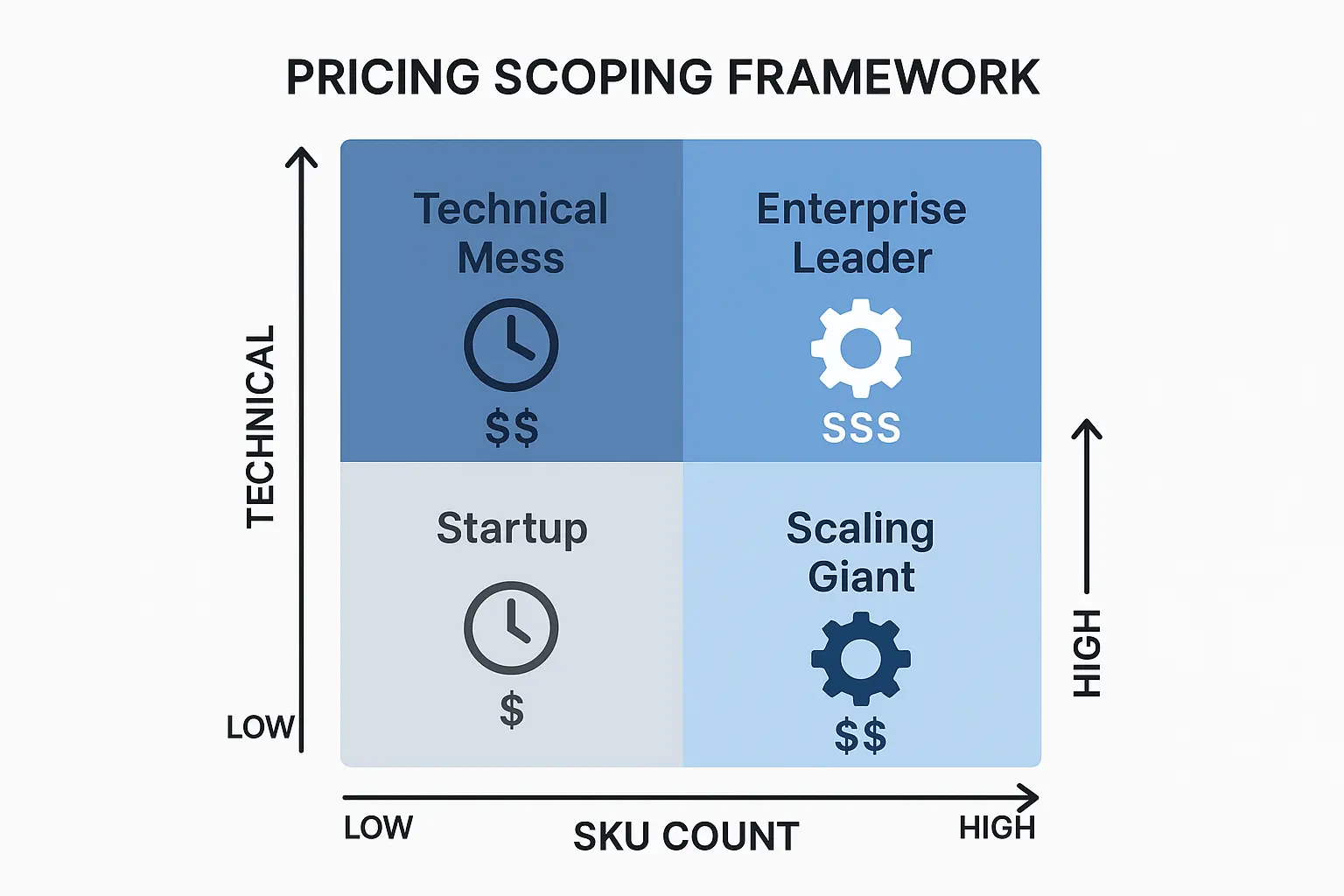
This guide offers a practical framework to help you scope and price e-commerce SEO projects accurately, moving beyond simple page counts to focus on the two factors that truly matter: SKU count (the scale) and technical debt (the complexity).
Why Standard SEO Pricing Fails for E-commerce
Trying to fit an e-commerce store into a “small business” SEO package is like trying to service a freight train with the tools for a sedan. The core mechanics are different, and the scale is orders of magnitude larger.
Research from Ahrefs highlights this complexity, revealing that the average e-commerce site has 25 technical SEO issues, with 11 of them considered high-priority. These aren’t minor fixes; they’re foundational problems that can cripple performance.
Standard pricing often overlooks e-commerce-specific challenges like:
- Massive Scale: Optimizing 10 product pages is a task. Optimizing 10,000 is a logistics operation.
- Faceted Navigation: Filters for size, color, and brand are great for users but notorious for creating a crawl budget nightmare of duplicate content if not handled correctly.
- Structured Data: Implementing correct Product, Review, and Organization schema across thousands of pages is critical for visibility but technically demanding.
- Platform Limitations: Every platform, from Shopify to Magento to custom builds, has its own quirks and limitations that impact SEO implementation.
You can’t price a project accurately until you understand the true size of the store and the depth of its existing problems.
The Two Pillars of E-commerce SEO Scoping
To price services profitably and set realistic client expectations, you need to evaluate every e-commerce project through two lenses: its scale and its complexity.
Pillar 1: SKU Count (The Scale Factor)
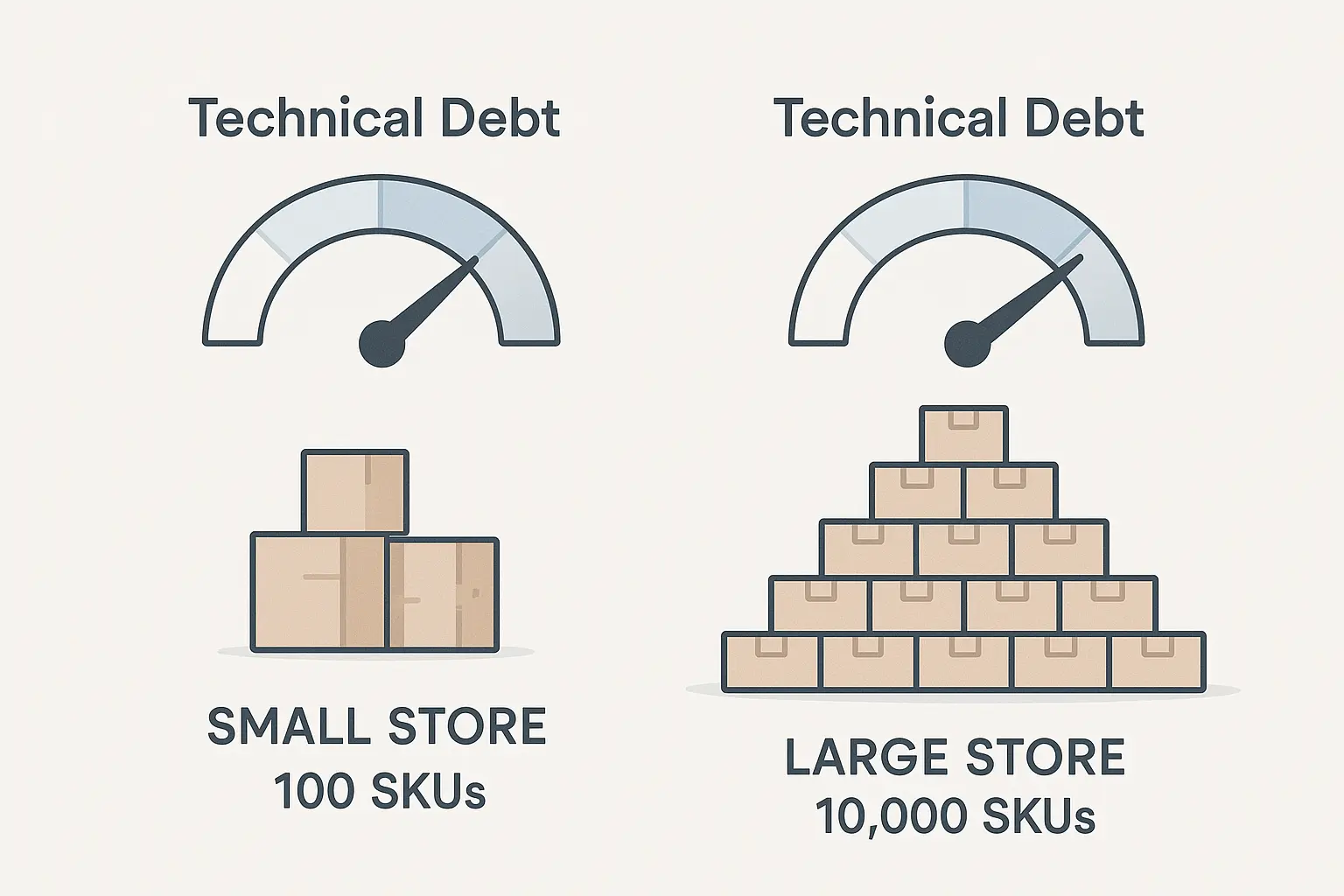
SKU, or Stock Keeping Unit, represents a single unique product. This single number is your first and most important indicator of project scale. It directly influences the time and resources needed for nearly every part of an SEO campaign.
Think of SKU count in tiers to create a baseline for your pricing.
- Small Store (< 100 SKUs): Often boutique shops or brands with a narrow product line. Manual optimization is feasible.
- Medium Store (100 – 1,000 SKUs): Requires a mix of manual and template-based optimization. The workload for keyword research and on-page SEO grows significantly.
- Large Store (1,000 – 20,000 SKUs): Manual optimization is impossible. Success depends on programmatic SEO, rule-based optimizations, and scalable content strategies.
- Enterprise Store (20,000+ SKUs): These are complex technical SEO undertakings, demanding advanced automation and deep platform expertise.
A higher SKU count exponentially increases the effort for keyword research, on-page optimization, internal linking, and content strategy. Your pricing must reflect this reality.
Pillar 2: Technical Debt (The Complexity Factor)
Technical debt is the “cleanup cost” you inherit from past development shortcuts, platform migrations, or a simple lack of SEO knowledge. It’s all the foundational work you have to do before you can even start driving growth.
It’s the stuff lurking below the surface. A website might look fine, but a quick audit can reveal a mess of issues that will sabotage any SEO effort.
Common sources of technical debt on e-commerce sites include:
- Duplicate Content: Caused by product variations, tracking parameters, and improperly implemented faceted search.
- Poor URL Structure: Unintelligible URLs that lack keywords and create organizational confusion.
- Slow Page Speed: Often due to unoptimized images across thousands of product pages and bloated code from third-party apps.
- Indexing & Crawlability Issues: Problems with robots.txt, sitemaps, or canonical tags that prevent Google from properly finding and ranking pages.
A high level of technical debt means you’ll spend the first three to six months of an engagement just fixing the foundation. This essential work needs to be scoped and priced as a distinct phase—often as a one-time project fee—before a monthly growth retainer begins.
A Practical Framework for Pricing Your Services
With these two pillars in mind, let’s build a simple, actionable framework.
Step 1: Establish Your SKU-Based Tiers
Start by creating a base monthly price for each SKU tier. This price is your foundation, covering the standard, ongoing work for a technically sound site of that size. Creating these tiers is a core part of building a scalable [white label SEO pricing model] that you can apply across clients.
- Small (<100 SKUs): Base Price (e.g., $1,500/mo)
- Medium (100-1,000 SKUs): Base Price x 1.5-2x (e.g., $2,500/mo)
- Large (1,000-20,000 SKUs): Base Price x 3-5x (e.g., $5,000/mo)
- Enterprise (20,000+ SKUs): Custom Quote
Step 2: Apply a Technical Debt Multiplier
Next, perform a thorough [ecommerce SEO audit] to assess the site’s technical health. This isn’t a quick automated report; it’s a deep dive into crawlability, indexation, speed, and structure.
Categorize the technical debt as Low, Medium, or High and use it as a multiplier on your initial project fee or the first few months of the retainer.
- Low Debt: (Modern Shopify site, good structure) – Multiplier: 1.0x. You can likely stick to your base retainer.
- Medium Debt: (Some duplicate content, moderate speed issues) – Multiplier: 1.5x. Propose a three-month “Foundation Phase” at a higher rate or a one-time cleanup fee.
- High Debt: (Legacy platform, severe indexing issues, widespread duplicate content) – Multiplier: 2.0x+. This requires a significant, separate technical cleanup project before any growth-focused retainer can begin.
Step 3: Layer on Business Goals and Competition
Finally, adjust your pricing based on the client’s goals and the competitiveness of their market.
- Aggressive Growth Goals: A client aiming to double revenue in 12 months will require a more intensive strategy (and a higher budget) than one looking for steady 10% growth.
- High Competition: Ranking for “women’s running shoes” is vastly more difficult than ranking for “handmade leather dog collars.” The budget must reflect the resources needed to compete.
Putting It All Together: Two Scenarios
Let’s see how this framework applies to two different potential clients.
Scenario A: The Boutique Candle Shop
- SKU Count: 50 (Small Tier)
- Platform: Shopify (Generally low technical debt)
- Audit Findings: Minor speed issues, some missing alt text. Technical Debt is Low.
- Pricing: Your standard “Small Tier” monthly retainer. The initial fixes can be handled within the first month.
Scenario B: The Industrial Parts Supplier
- SKU Count: 18,000 (Large Tier)
- Platform: A 12-year-old custom-built CMS.
- Audit Findings: Massive faceted search duplication, no canonical tags, slow database queries, HTTP and HTTPS mixed content. Technical Debt is High.
- Pricing: You’d propose a two-phase engagement:
- Phase 1 (Months 1-4): A large, one-time project fee to resolve the critical technical debt. This is priced based on your “Large Tier” baseline multiplied by the “High Debt” factor (e.g., $7,500/mo for 4 months).
- Phase 2 (Month 5+): A monthly retainer based on your standard “Large Tier” price to focus on content, link building, and conversion optimization.

FAQ: Common Questions on Pricing E-commerce SEO
Should I charge a one-time setup fee?
Yes, almost always for e-commerce. Frame it as a “Technical Foundation Project” or “SEO Onboarding Phase.” It covers the intensive audit, cleanup, and strategy development required at the start and ensures you’re not trying to build on a broken foundation.
What’s better: retainers, projects, or hourly?
A hybrid model is often best. Use a project-based fee for the initial technical debt cleanup. Once the site is healthy, transition to a monthly retainer for ongoing growth, content creation, and authority building. Hourly is rarely ideal as it can penalize efficiency.
How do I explain this complexity to a client?
Use analogies. Explain that you’re like an architect hired to build a skyscraper. Before you can start building up, you have to inspect the foundation. If it’s cracked, it must be repaired first—otherwise, everything you build on top will eventually collapse. The audit is your inspection, and the technical cleanup is your foundation repair.
What tools can help me assess technical debt?
While a full audit requires expertise, tools like Screaming Frog, Ahrefs’ Site Audit, and Semrush’s Site Audit are essential starting points. They help quantify the scale of any issues, and an effective [agency SEO platform] can further streamline the process by automating reporting and tracking across multiple clients.
From Pricing to Partnership
Moving away from flat-rate packages to a scoping framework based on SKU count and technical debt does more than just protect your profit margins. It transforms your agency’s role.
You stop being a commodity service provider quoting a price and start acting as a strategic partner diagnosing problems and presenting a clear roadmap for growth. This approach builds trust, sets realistic expectations, and positions your agency as the expert they need.
By pricing the work correctly, you give yourself the resources to deliver the results your clients are truly paying for.