
Ever feel like you’re creating brilliant, insightful content for a client, only for it to land with a quiet thud? You’ve targeted the perfect keyword and solved a real problem, yet the needle on sales-qualified leads barely moves.
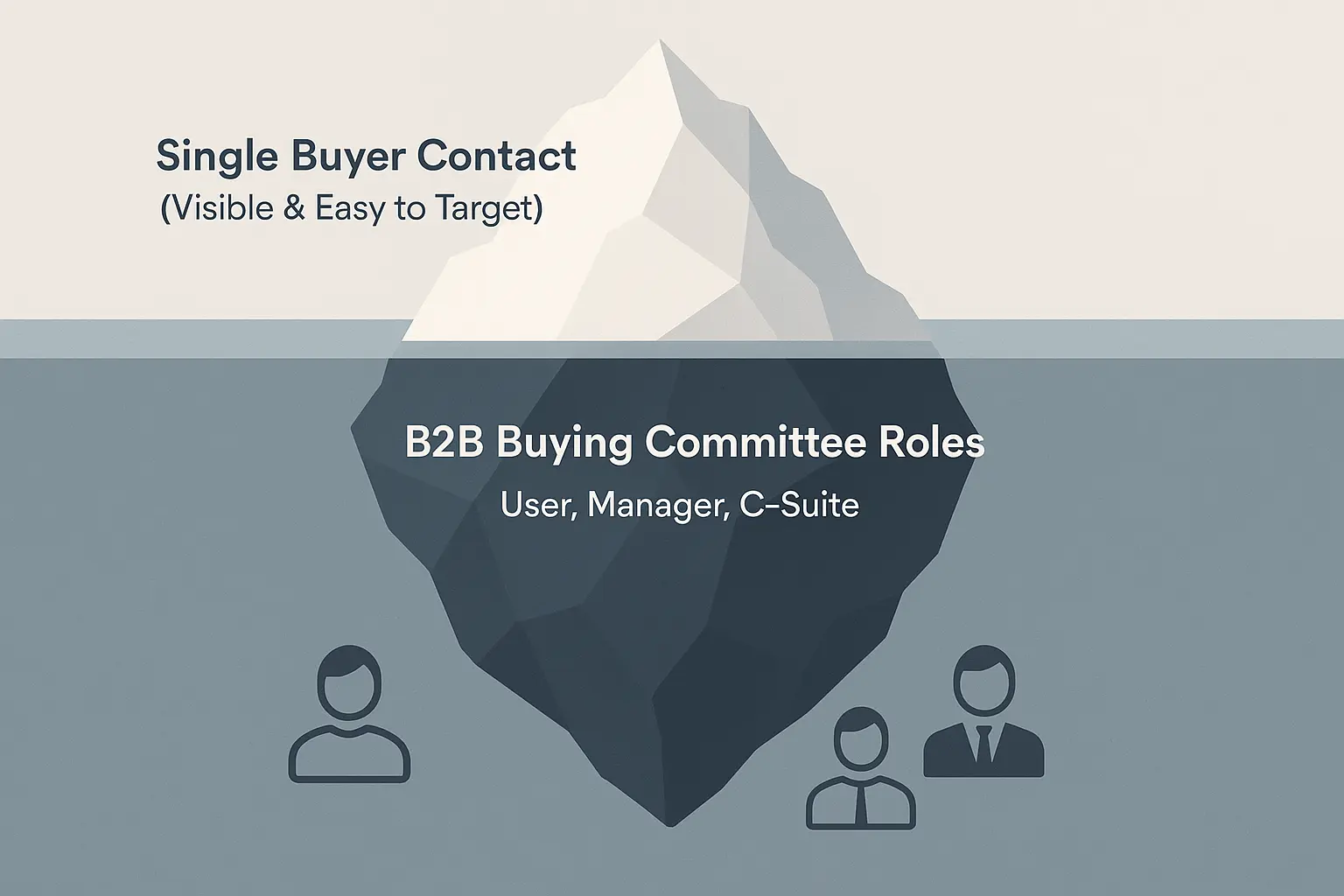
If this sounds familiar, you might be talking to the right person… but missing the nine other people in the room who actually sign the check.
Research from Gartner reveals that a typical B2B purchase involves 6 to 10 decision-makers, each with their own questions, priorities, and pain points. This group, known as the buying committee, is the invisible audience for your SEO strategy. If you’re only targeting one of them, you’re only doing 10% of the job.
Why Your ‘One-Size-Fits-All’ B2B SEO Strategy Is Failing
In the B2C world, the path to purchase is often straightforward. Someone wants new running shoes, they search ‘best trail running shoes,’ read a few reviews, and buy.
The B2B journey is a winding road with multiple pit stops. According to Google and Forrester, the average B2B researcher conducts 12 searches before even landing on a specific brand’s site. They aren’t just buying a product; they’re vetting a long-term partner for a high-stakes decision.
This complexity is amplified by a massive shift in buyer behavior:
-
Self-Service is the New Standard: According to TrustRadius, 57% of B2B buyers now make purchase decisions without ever talking to a sales rep. Your content is no longer a supplement to the sales team; it is the sales team.
-
Millennials are in Charge: With 45% of B2B buyers now being millennials (Demand Gen Report), the expectation for digital-first, self-guided research has become the norm. They expect to find answers on their own terms, through search engines and video content.
-
Everyone has a different ‘Why’: The end-user who will be in the software daily has entirely different concerns than the CTO worried about security or the CFO focused on ROI. A single piece of content can’t possibly speak to all of them effectively.
Ignoring this reality means you’re likely creating content for the most visible member of the committee—the end-user—while failing to provide the proof points, business cases, and financial arguments needed by the budget holders.
Meet Your Audience: The Three Key Players in Every B2B Deal
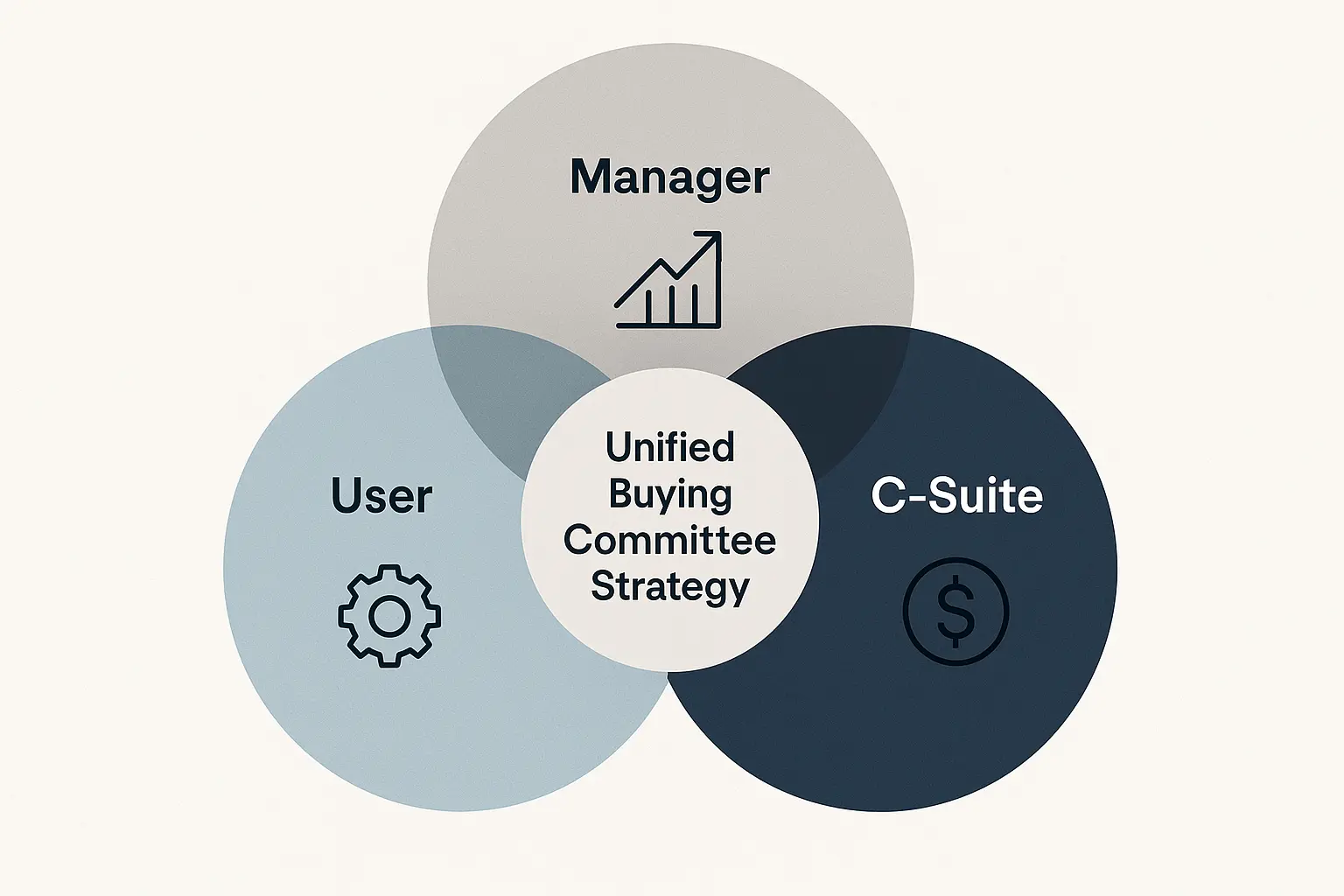
To build a strategy that resonates, you need to stop thinking about a single ‘persona’ and start thinking about the key roles within the buying committee. While the exact titles vary, they generally fall into three archetypes: the User, the Manager, and the C-Suite.
Each has a different job to be done, which means they use entirely different language when they turn to Google for answers.
Let’s break down how to map your keyword strategy to each of these crucial players.
A Three-Tiered Framework for B2B Keyword Mapping
Imagine your agency’s client sells a sophisticated project management SaaS platform. A one-size-fits-all keyword strategy might target ‘project management software.’ But a committee-based approach goes much deeper.
Tier 1: The End-User (The ‘How’)
This is the person whose daily life will be most affected by the purchase. They’re the designers, developers, marketers, or analysts who will be in the software every day.
-
Primary Concerns: ‘Will this make my job easier? Is it intuitive? Does it solve my specific, tactical frustrations?’
-
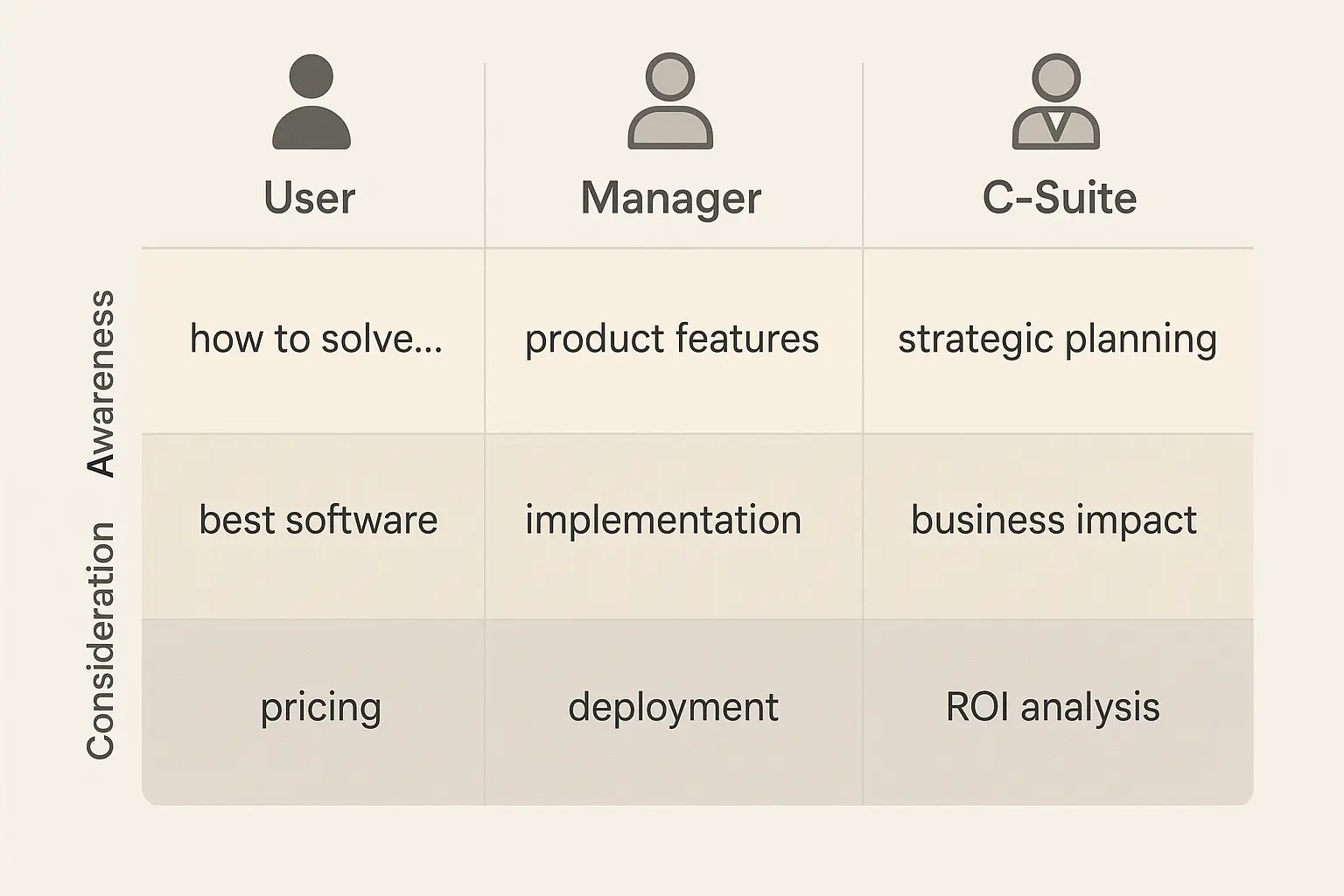
Keyword Intent: Their searches are problem-focused and practical. They use modifiers related to their job function, specific tasks, or frustrations.
Examples: ‘how to manage creative workflows,’ ‘best collaboration tool for remote designers,’ ‘asana alternative for bug tracking.’ -
Content That Resonates: Your content should be hands-on and helpful. Think detailed tutorials, how-to guides, and feature comparisons. With 70% of B2B buyers watching videos on their purchase path (FocusVision), screen-recorded demos showing the product in action are incredibly powerful here.
Tier 2: The Manager (The ‘What’)
This is the team lead, department head, or director. They aren’t just thinking about one person’s workflow; they’re responsible for the entire team’s output, efficiency, and integration with other departments.
-
Primary Concerns: ‘How will this improve my team’s productivity? Will it integrate with our existing tools? What is the implementation process like? How do I get my team to adopt it?’
-
Keyword Intent: Their searches are focused on process, efficiency, and management. They look for solutions that address team-level or departmental challenges. A thorough Content planning process is key to capturing this mid-funnel intent.
Examples: ‘project management software integration with Slack,’ ‘how to improve team reporting efficiency,’ ‘project management software implementation checklist.’ -
Content That Resonates: They need to see the bigger picture. In-depth case studies showing how a similar team improved productivity, detailed implementation guides, and articles comparing process methodologies are a perfect fit.
Tier 3: The C-Suite / Decision-Maker (The ‘Why’)
This is the CFO, CTO, or VP who holds the budget. They may never log into the software, but they’re ultimately responsible for the purchase.
-
Primary Concerns: ‘What is the return on this investment? How does this impact our bottom line? Is it secure and compliant? How does it compare to competitors on price and value?’
-
Keyword Intent: Their searches are strategic, financial, and risk-averse. They use keywords related to cost, ROI, security, and high-level business impact.
Examples: ‘project management software ROI calculator,’ ‘enterprise-grade secure collaboration platform,’ ‘[client’s brand] vs [competitor] pricing.’ -
Content That Resonates: Forget features; talk about business outcomes. This is where you provide ROI calculators, whitepapers on industry trends, security compliance documentation, and high-level case studies that focus on revenue growth or cost savings. A deep competitor analysis is crucial for creating content that positions your client as the superior financial choice.
Bringing It All Together: From Keywords to a Cohesive Content Journey
This framework isn’t about creating three times the content, but about being more strategic. The goal is to build a web of interconnected content where a user can find their ‘how-to’ guide, their manager can find the implementation plan linked within it, and the CFO can access an ROI calculator from the main solution page.
When you map your content to the entire committee, you create a seamless research journey. Each stakeholder finds the exact information they need to champion the solution internally, paving the way for a faster, more confident purchasing decision. This holistic approach is the foundation of a truly Conversion-focused SEO strategy that drives measurable business growth, not just rankings.
Frequently Asked Questions (FAQ)
What exactly is a B2B buying committee?
A B2B buying committee is the group of individuals within a company who are all involved in a purchasing decision. This typically includes the end-user, their manager, technical experts (like IT), finance or procurement (the budget holders), and executive leadership.
How is B2B keyword research different from B2C?
B2C keyword research often targets a single decision-maker with transactional or informational intent. B2B keyword research must account for a longer sales cycle and multiple stakeholders, each with different informational needs—from tactical ‘how-to’ queries to strategic ‘ROI’ and ‘cost’ queries.
How do I find out who is on my client’s buying committee?
The best source of information is your client’s sales and customer success teams. They talk to these people every day. Ask them: ‘Who is typically involved in a deal? Who asks the tough questions about price? Who is most concerned with daily usability?’ Analyzing the job titles of existing customers on LinkedIn is another great way to identify patterns.
Does this framework mean I need to create three times the content?
Not at all. The goal is to be more strategic with the content you create. You can often address multiple stakeholders by intelligently linking between articles. For example, a ‘how-to’ guide for a user could link out to a more strategic piece about team efficiency for their manager. It’s about building pathways, not just isolated pages.
Your Next Step: From Awareness to Action
The modern B2B landscape is too complex for a one-dimensional SEO strategy. Success requires speaking the distinct languages of everyone at the decision-making table. By mapping your keywords and content to the User, the Manager, and the C-Suite, you transform your client’s website from a simple brochure into a powerful, self-service resource that guides the entire buying committee toward a confident ‘yes.’
Start today. Pick one of your B2B clients and ask: are we just talking to the user, or are we equipping the entire team to make a case for our solution? The answer may reveal your biggest opportunity for growth.