
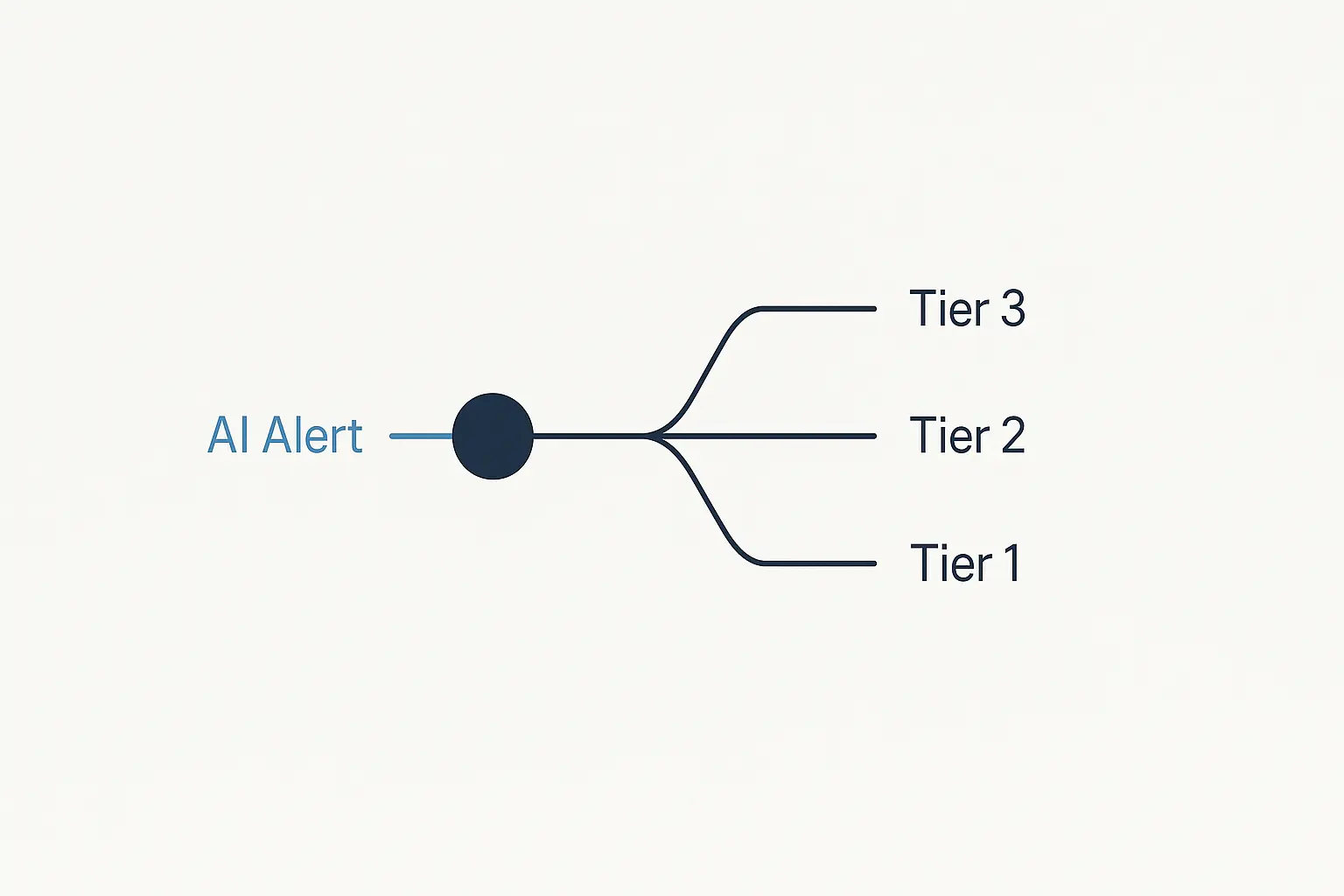
It’s 10 PM. An automated alert hits your inbox with a subject line that makes your heart sink: CRITICAL RANKING DROP DETECTED for Client XYZ.
Your mind races. Is it a Google algorithm update? A technical glitch? Did a competitor just leapfrog your client for their most valuable keyword?
In the world of SEO, where 92.96% of global traffic comes from Google Search, a sudden drop isn’t just a data point—it’s a direct threat to a client’s bottom line.
AI-powered monitoring tools are fantastic at flagging these fires, but they don’t tell you how to put them out. Reacting with panic leads to wasted hours and frantic, unfocused fixes. A measured, methodical approach turns a crisis into a demonstration of your agency’s expertise.
That’s where a tiered escalation path comes in—a predefined crisis response plan that categorizes every AI-detected alert, ensuring your reaction always matches the reality of the situation.
Why You Need More Than Just an Alert
Imagine a smoke detector. It screeches whether you’ve burned toast or the kitchen is engulfed in flames. The sound is the same, but the required response is drastically different. SEO alerts work the same way.
Without a plan, every alert feels like a five-alarm fire. A tiered system helps you differentiate the burnt toast from the real emergency, allowing you to effectively allocate your most valuable resource: your team’s time.
Considering Google makes thousands of updates to its algorithm each year, this discipline is critical. Most are minor tremors, but some are seismic shifts. A tiered response plan is your agency’s playbook for navigating this constantly changing landscape with confidence.
Building Your Tiered Escalation Plan
Classify every alert into a priority tier, from a low-priority watch and wait to an all hands on deck emergency. Each tier has its own predefined set of diagnostic steps.
Let’s break down a practical, three-tier framework.
Tier 3 (P3): Minor Tremors — The ‘Watch and Wait’ Alert
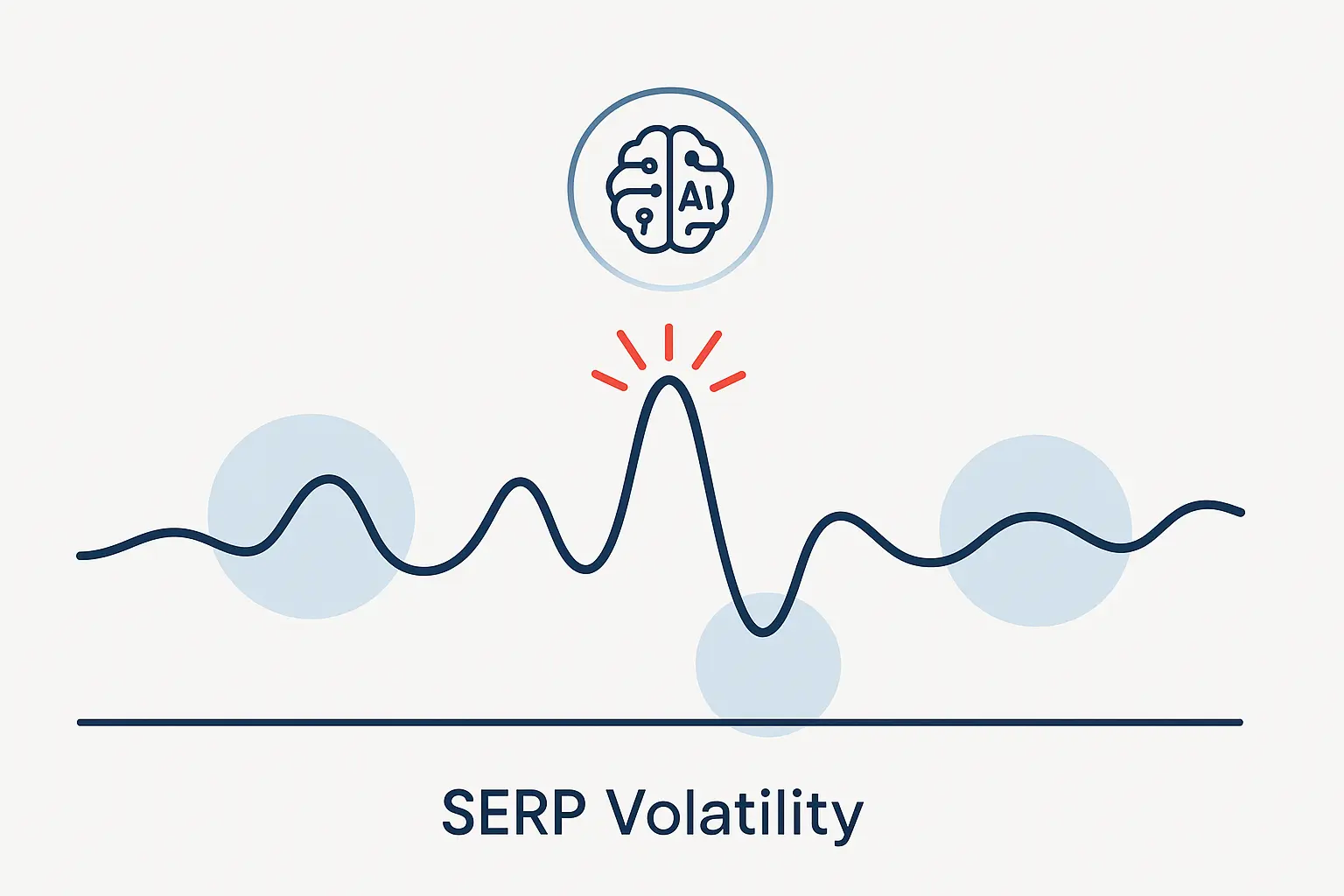
This is your most common alert—the background noise of the SERPs.
What It Looks Like: A drop of 2-5 positions for a handful of non-critical, long-tail keywords. A single blog post fluctuates slightly.
Potential Causes: Normal daily SERP flux, minor algorithm adjustments, or a competitor slightly refreshing their content.
Your Action Plan:
- Acknowledge and Log: Note the alert in your project management tool. Don’t ignore it, but don’t jump on it either.
- Monitor for 48 Hours: More often than not, these rankings bounce back on their own. Reacting too quickly can lead you to fix something that wasn’t broken.
- Quick SERP Analysis: Take five minutes to look at the search results. Did a new video carousel or People Also Ask box appear, pushing organic results down? This often indicates a feature change, not a ranking loss.
- No Client Communication: Contacting a client about every P3 alert will only create unnecessary anxiety. Your job is to absorb this low-level volatility.
Tier 2 (P2): Significant Shifts — The ‘Investigate Now’ Alert
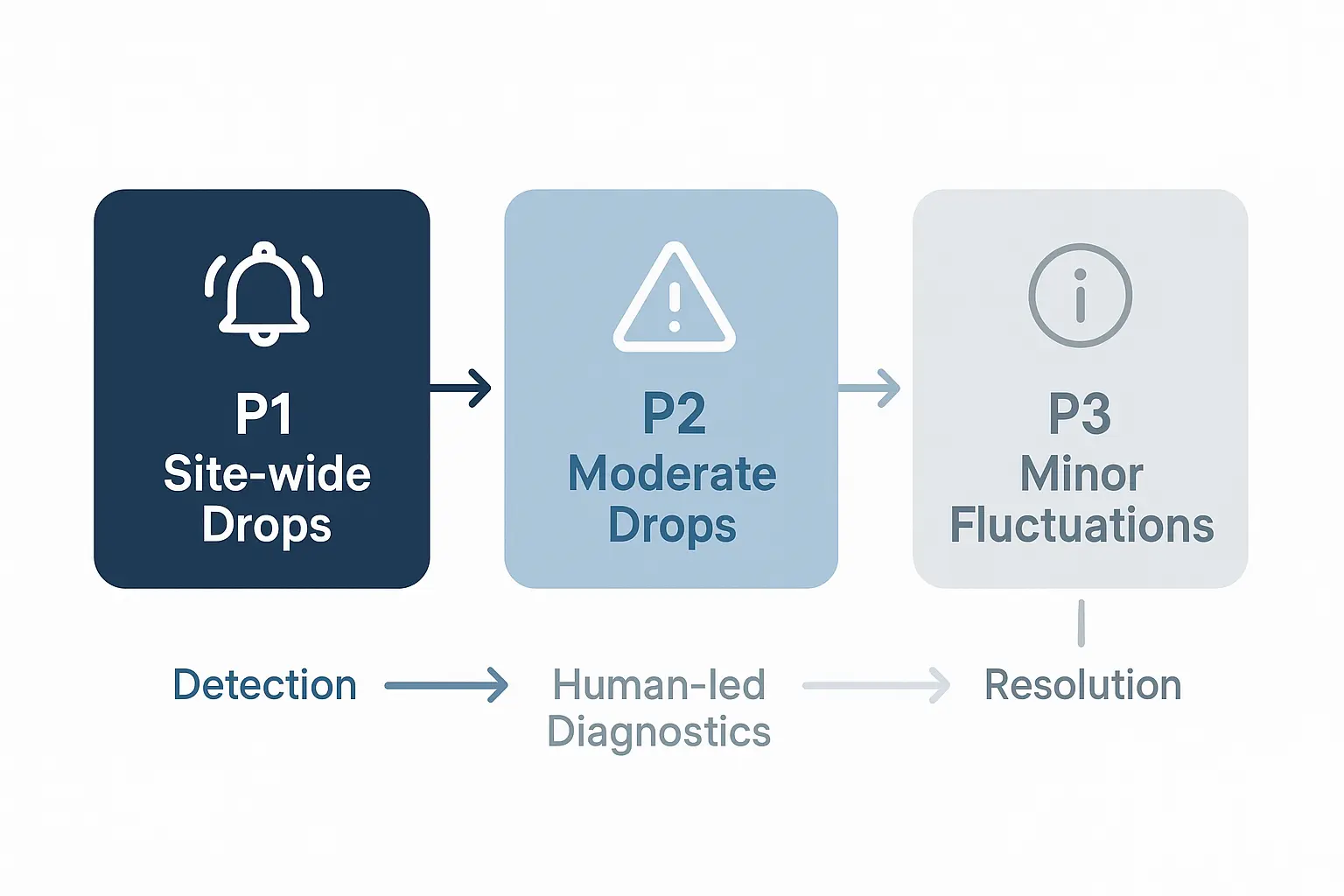
A P2 alert is a clear signal that something has changed and requires your attention. It isn’t a catastrophe yet, but it could become one if ignored.
What It Looks Like: A high-value keyword group falls off page one. A key service or product category page drops 10+ positions. Organic traffic to a specific landing page dips by more than 25%.
Potential Causes: A recent site change (e.g., a developer accidentally added a noindex tag), a targeted algorithm update like a Helpful Content Update, or aggressive new content from a competitor.
Your Action Plan:
-
Immediate Triage (The First 30 Minutes):Is the page still indexed? Use the site:yourURL.com command and check Google Search Console’s URL Inspection tool.Was there a recent deployment? Check your changelogs or ask the client’s development team if anything on the site was modified in the last 24 hours.Check GSC for messages. Look for any new manual actions or security warnings.
-
Deeper Diagnostics (The Next 2 Hours):Run a Quick Crawl: Use a tool like Screaming Frog to look for new crawl errors, redirect chains, or changes to canonical tags.Analyze the SERP Winners: Who took your spot? Analyze their page. Did they add new content, get new backlinks, or improve their technical performance?Review Your Own Page: Was any content accidentally removed? Are internal links still pointing to the page?
-
Proactive Client Communication: Send a calm, confident email. “Hi Client, our monitoring has flagged a ranking fluctuation for page/keyword group. This is not uncommon, and our team is already running diagnostics to identify the cause. We’ll provide a full update within 24 hours.” This projects confidence and control.
For many agencies, handling P2 investigations across multiple clients is where their bandwidth is stretched to the breaking point. That’s why scalable systems, often achieved through white-label SEO execution, become essential for maintaining service quality without burning out your team.
Tier 1 (P1): Code Red — The ‘All Hands on Deck’ Alert
This is the event you hope never happens, but you must be prepared for. A P1 alert indicates a critical, site-wide issue that is costing your client money every minute.
What It Looks Like: The entire site is de-indexed or has disappeared for all branded keywords. A massive, site-wide drop across nearly all tracked keywords. A manual action penalty from Google.
Potential Causes: A disastrous robots.txt misconfiguration blocking all crawlers, a botched site migration, a server failure, or a clear violation of Google’s guidelines resulting in a penalty.
Your Action Plan:
- Immediate Escalation: This is a drop-everything moment. Assemble your core SEO team (and the developer, if possible) on an urgent call.
- Divide and Conquer Diagnostics:One person owns GSC: Check for manual actions, security issues, and coverage errors.One person checks the technical vitals: robots.txt, .htaccess, server response codes, and DNS settings.One person reviews recent site history: Any recent plugin updates, platform changes, or migrations?
- Urgent Client Call: Do not email. Call your client immediately. Be direct and transparent. “We’ve detected a critical site-wide issue. Our entire team is focused on diagnosing the root cause right now. We suspect Potential Cause X or Y and will be in constant communication as we execute a recovery plan.”
- Formulate and Execute a Recovery Plan: Once the cause is identified (e.g., a Disallow: / in robots.txt), the fix is often straightforward. Finding it quickly is the critical part. Document the entire process for a post-mortem report.
From Reactive Firefighting to Proactive Trust-Building
A structured response plan does more than solve problems efficiently—it fundamentally changes the client relationship. When clients know you have a plan for the worst-case scenario, their trust in your agency deepens.
You move from being a vendor they hire to a partner they rely on. That shift is crucial because SEO is a long-term investment. Protecting your gains is just as important as making them, especially when you remember that SEO drives 1000%+ more traffic than organic social media. A swift, professional response to a ranking drop protects that vital traffic channel and reinforces your value.
This methodical approach is the hallmark of mature SEO operations, whether they are managed in-house or through partners that provide AI-powered SEO automation and strategic oversight.
Frequently Asked Questions (FAQ)
Q1: How often do search engine rankings normally fluctuate?
Rankings fluctuate daily. Google is constantly testing results and making minor algorithm updates thousands of times per year. That’s why a Tier 3 (P3) category is so important—it helps you ignore the harmless noise and focus on significant signals.
Q2: Should I tell my client about every single ranking drop?
Absolutely not. This will only undermine their confidence and create alert fatigue. Your tiered plan is an internal process that allows you to filter what’s important. You communicate with the client only for confirmed Tier 2 issues and, of course, all Tier 1 emergencies.
Q3: What is the most common cause of a major (P1) ranking drop?
Technical errors are the most frequent culprits. The most common is an incorrect robots.txt file that blocks Googlebot from crawling the site. The second most common is a mismanaged site migration where redirects were not implemented correctly.
Q4: Can AI tools fix these problems automatically?
Not yet. AI is exceptionally good at detection—identifying the what and when at a scale no human could match. However, the diagnosis (why) and the strategic solution (how to fix it) still require human expertise. The best systems combine AI for monitoring with a smart, human-led plan for action. A successful omnichannel SEO strategy often relies on this blend of automation and expert insight to correlate drops with activity across different marketing channels.
Your Next Step: Formalize Your Plan
You don’t need complex software to get started. Open a document and define your own P1, P2, and P3 triggers and response steps. Discuss it with your team. The simple act of writing it down transforms a panicked reaction into a professional process.
By having a plan ready before the alarm sounds, you ensure that when a crisis hits, you’re not just a firefighter—you’re the calm, collected fire chief who already knows exactly what to do.