

You wake up on a Monday morning, grab your coffee, and open your project management dashboard. Instead of a calm start to the week, you see a flashing red alert: “CLIENT-SITE.COM – LCP METRIC FAILED: 4.2s.”
The alert was automatically created Saturday at 2:15 PM, just hours after a developer pushed a minor update that inadvertently added a massive, unoptimized hero image.
Instead of a client calling in a panic on Monday, your team is already rolling out a fix. This isn’t a fantasy; it’s the power of moving from reactive, manual spot-checks to a proactive, automated monitoring system. It’s the difference between being a firefighter and an architect.
The Hidden Cost of “Checking In” on Site Health
For many agencies, technical SEO monitoring is a manual, time-consuming ritual. It involves periodically logging into Google Search Console, running a PageSpeed Insights report, or using a browser extension to check on a client’s site. While well-intentioned, this approach is inherently flawed.
It’s reactive. You find problems only after they’ve happened—and often, after they’ve already impacted rankings and user experience.
It’s not scalable. The time it takes to manually check one site is manageable, but what about ten sites? Or 50? According to a survey by Aira, nearly half of SEO professionals spend 11-20 hours per week on technical tasks. Much of that time is spent on repetitive monitoring—tasks a machine could do better, faster, and more consistently.
The modern agency needs a system: an automated, hands-off framework that acts as a 24/7 watchdog for every client’s website.
What is API-Driven Monitoring?
Think of it like a sophisticated security system for your house. Instead of walking around to check if every window is locked, you install sensors that automatically alert you the moment one is opened.
In our world, the API (Application Programming Interface) is what allows different tools to “talk” to each other. An API-driven monitoring framework uses these connections to:
-
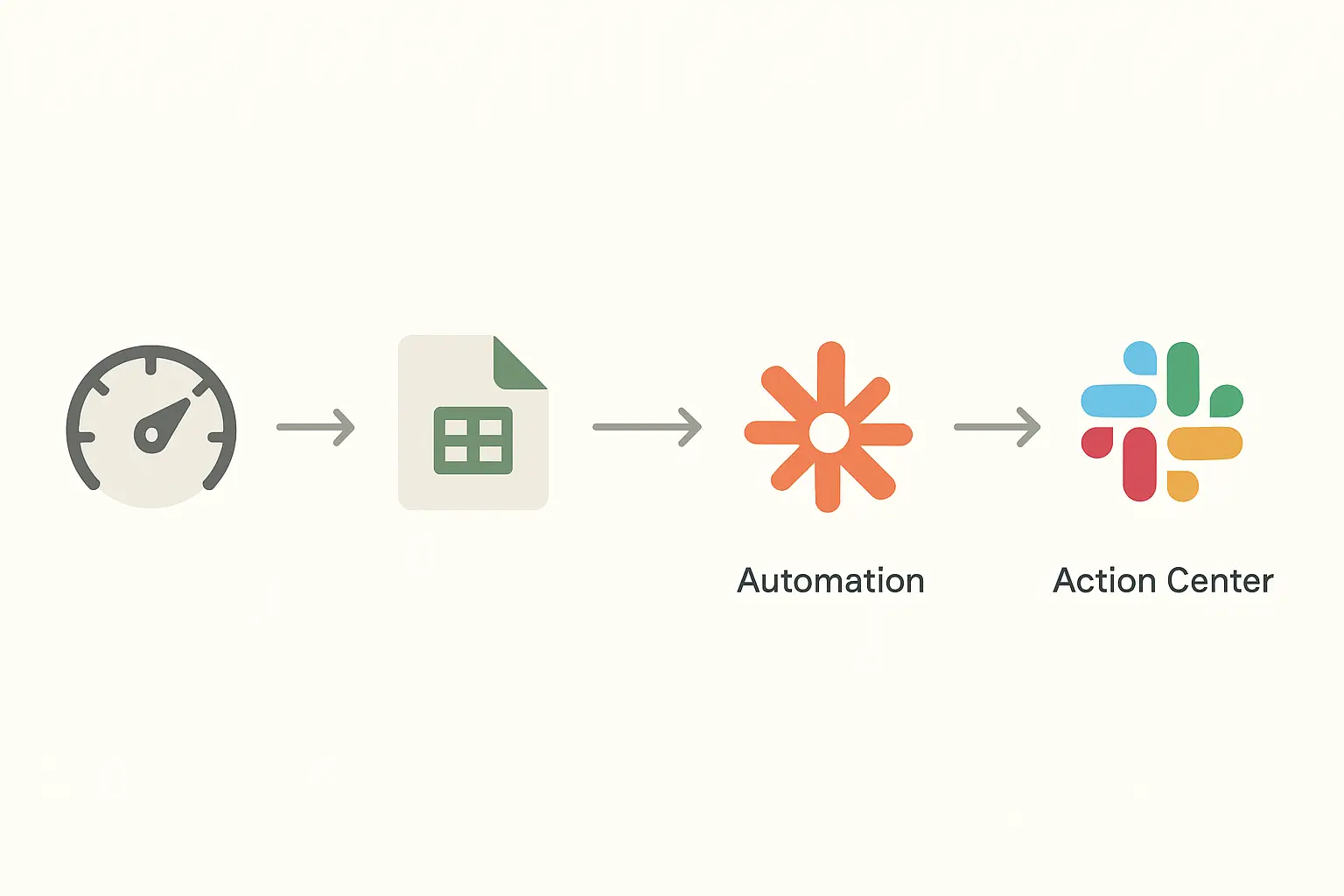
Fetch Data: Automatically pull key performance metrics from a source like Google’s PageSpeed Insights API.
-
Analyze Data: Compare the fetched data against predefined thresholds (e.g., is the LCP score below 2.5 seconds?).
-
Trigger Actions: If a threshold is crossed, automatically send an alert to your team via Slack, create a task in your project management tool, or fire off an email.
This seemingly simple process is the backbone of truly scalable technical SEO.
Setting Up Your Automated Core Web Vitals Monitor
Core Web Vitals (CWV) are non-negotiable for performance. Google’s own data shows that users are 24% less likely to abandon a page if it meets the recommended CWV thresholds. Waiting for a GSC notification that your scores have dropped means you’ve likely been providing a poor user experience for weeks.
Here’s a high-level framework for building your own automated CWV monitor:
Step 1: Access the Data Source (PageSpeed Insights API)
Google offers its PageSpeed Insights tool via a free API. You’ll need an API key from the Google Cloud Platform Console, which acts as your unique password to request data.
Step 2: Define Your “Red Flag” Thresholds
You need to tell your system what “bad” looks like. The standard thresholds are an excellent place to start:
- Largest Contentful Paint (LCP): Alert if > 2.5s
- Interaction to Next Paint (INP) / First Input Delay (FID): Alert if > 100ms
- Cumulative Layout Shift (CLS): Alert if > 0.1
Step 3: Schedule the Automated Check
Using a simple script or a no-code automation tool like Zapier or Make.com, you can schedule a “job” to run daily or weekly. This job will call the PageSpeed Insights API for each client URL you want to monitor.
Step 4: Create the Automated Alert Workflow
This is where automation takes over. You’ll configure a simple rule: IF the LCP value returned by the API is greater than 2.5, THEN create a new task in Asana titled “[Client Name] – LCP Alert” and assign it to your technical SEO lead.

With this system, you’re no longer hunting for problems. Problems are delivered directly to your workflow, complete with the data needed to start debugging. Once an alert triggers, the real work begins—diagnosing the root cause and implementing a fix, a fundamental part of any robust white-label SEO execution plan.
Don’t Forget Uptime and Status Code Monitoring
A fast site is great, but a site that’s down is invisible to users and search engines. Uptime monitoring is just as critical as performance monitoring.
While you can use third-party tools for this, the same API-driven principle applies. A good uptime monitor doesn’t just check if a site is “up” or “down”—it checks the server’s HTTP status code.
- 200 OK: Everything is good.
- 404 Not Found: A broken page. A single 404 isn’t an emergency, but a sudden spike could signal a major issue with a recent CMS update or URL change.
- 5xx Server Error: This signals an emergency. A 500 or 503 error means the server itself is failing, and the entire site is likely inaccessible.
Your automated monitor can be programmed to treat a 5xx error with the highest priority, sending an instant, multi-channel alert to your team. This constant vigilance is a perfect use case for AI-powered SEO automation, which can run thousands of these checks across an entire client portfolio without breaking a sweat.
The Agency Advantage: Scaling Proactive SEO
Implementing an API-driven monitoring framework transforms how your agency operates and the value you deliver.
-
From Reactive to Proactive: You fix issues before clients even know they exist. This builds incredible trust and demonstrates undeniable value.
-
Scale Without Overload: You can onboard five new clients and simply add their URLs to your monitoring script. Your capacity increases, not your workload.
-
Protect Client Revenue: Every minute a site is down or performing poorly, your client is potentially losing leads and sales. Proactive monitoring is a direct investment in their bottom line.
-
Free Up Your Experts: By automating the mundane, you allow your talented SEO strategists to focus on what humans do best: complex problem-solving, creative strategy, and building client relationships.
This dashboard view isn’t just data; it’s peace of mind. It’s the confidence that comes from knowing you have a system watching over your clients’ most valuable digital assets, 24/7.

FAQ: Getting Started with Automated Monitoring
Is this too technical for a non-developer?
Not at all. While you can build this with code, no-code platforms like Zapier have built-in integrations for many tools. The key is understanding the logic of the workflow. For more complex setups, this is often a task for a dedicated agency SEO partner who has these systems already in place.
How often should I run these checks?
It depends on the metric. Uptime and critical status code checks should run every 1-5 minutes. Performance metrics like Core Web Vitals can be checked daily or weekly, as they tend to be less volatile.
What are the most important metrics to monitor besides CWV and uptime?
Start with the basics, but a mature system can also watch for unexpected changes in your robots.txt file, large shifts in the number of pages in a sitemap, and expiring SSL certificates.
Doesn’t Google Search Console already alert me to these issues?
GSC is an invaluable tool, but its alerts can be delayed by days or even weeks. An API-driven system gives you near-real-time feedback. More importantly, it allows you to pipe that feedback directly into your team’s existing workflow instead of relying on someone to check their email.
Your Next Step: From Monitoring to Mastery
Putting out fires is part of the job. But the best agencies build fireproof buildings.
By embracing an API-driven approach to technical monitoring, you shift your team’s focus from manual, repetitive labor to high-value, strategic action. You build a scalable, efficient, and proactive SEO service that not only protects your clients but also sets your agency apart.
Understanding this framework is the first step. The next is to implement it across your entire client portfolio, turning a powerful concept into a cornerstone of your agency’s operations.