

Ever feel like you’re running a race against yourself? You pour resources into creating multiple articles around a core topic, hoping one will stick.
You might have a blog post on “email marketing tips,” another on “best practices for email marketing,” and a third on “how to improve email campaigns.” While they might sound distinct to you, in Google’s eyes, they’re all trying to do the same job. The result? None of them perform as well as they could.
If this sounds familiar, you’re not alone. An Ahrefs study found it’s common for a single website to have ten or more pages ranking for the same keyword. You’re not just competing with other sites—you’re competing with yourself.
This is keyword cannibalization, and it’s one of the most common, yet fixable, roadblocks to SEO success. But fixing it manually is a nightmare of spreadsheets and guesswork. The modern solution is to use AI to see your content the way search engines do.
What Is Keyword Cannibalization, Really?
Keyword cannibalization happens when multiple pages on your website target the same or very similar keywords and, more importantly, the same search intent.
Think of it this way: You send two of your best athletes to compete in the same race. Instead of producing one clear winner, they split their strength, confuse the judges (search engines), and potentially lose to a competitor who sent a single, focused champion.
When Google crawls your site and finds multiple pages that could answer the same query, it gets confused. Which page is the most authoritative? Which one should it rank? Unable to decide, it might:
- Rank the “wrong” page: A less relevant or lower-converting page might show up in search results.
- Dilute your authority: Instead of one strong page earning all the backlinks and engagement, those signals are split across several weaker pages.
- Cause fluctuating rankings: Google might constantly swap which of your pages it shows in search results, leading to unstable traffic.
This internal competition quietly sabotages your SEO efforts. It can make your content strategy look like it isn’t working when the real problem is a messy architecture.
The Hidden Costs of a Messy Content Structure
Keyword cannibalization isn’t just a technical SEO issue. It’s a resource drain that impacts your agency’s efficiency and your clients’ results.
-
Wasted Content Efforts: A Search Engine Journal survey revealed that 65% of SEOs find content creation to be their most difficult task. When your team creates redundant articles, you’re spending time and budget on content that actively works against your goals—building horizontal clutter instead of vertical authority.
-
Diluted Link Equity: Authority is built through backlinks. Research from Backlinko shows that comprehensive, in-depth content earns significantly more backlinks. When you have five average articles on a topic instead of one powerhouse guide, you split your potential for earning valuable links and weaken your entire site’s authority.
-
Confusing User Experience: A user who lands on your “Beginner’s Guide to Social Media” might miss your more comprehensive “Ultimate Guide to Social Media Strategy” simply because they are competing. This creates a fragmented journey and prevents users from finding your best, most valuable content.
Ignoring cannibalization is like trying to fill a leaky bucket. You can keep pouring in more content, but you’ll never achieve the authority and rankings you’re capable of until you patch the holes in your site architecture.
The Modern Fix: AI-Powered Keyword Clustering
For years, the go-to method for finding cannibalization involved exporting search data into a massive spreadsheet, manually filtering by keyword, and visually scanning for duplicate URLs. It was time-consuming, prone to error, and nearly impossible to do at scale.
Today, we have a far more elegant solution: AI-powered keyword clustering.
Keyword clustering is the process of grouping keywords based on shared search intent. Instead of just lumping “SEO tips” and “SEO best practices” together because the words are similar, AI analyzes the actual search engine results pages (SERPs) for thousands of keywords.
If the same URLs consistently rank for a set of keywords, the AI groups them into a single “cluster.” Each cluster represents a single topic—a signal that you should ideally have just one piece of content to cover it.
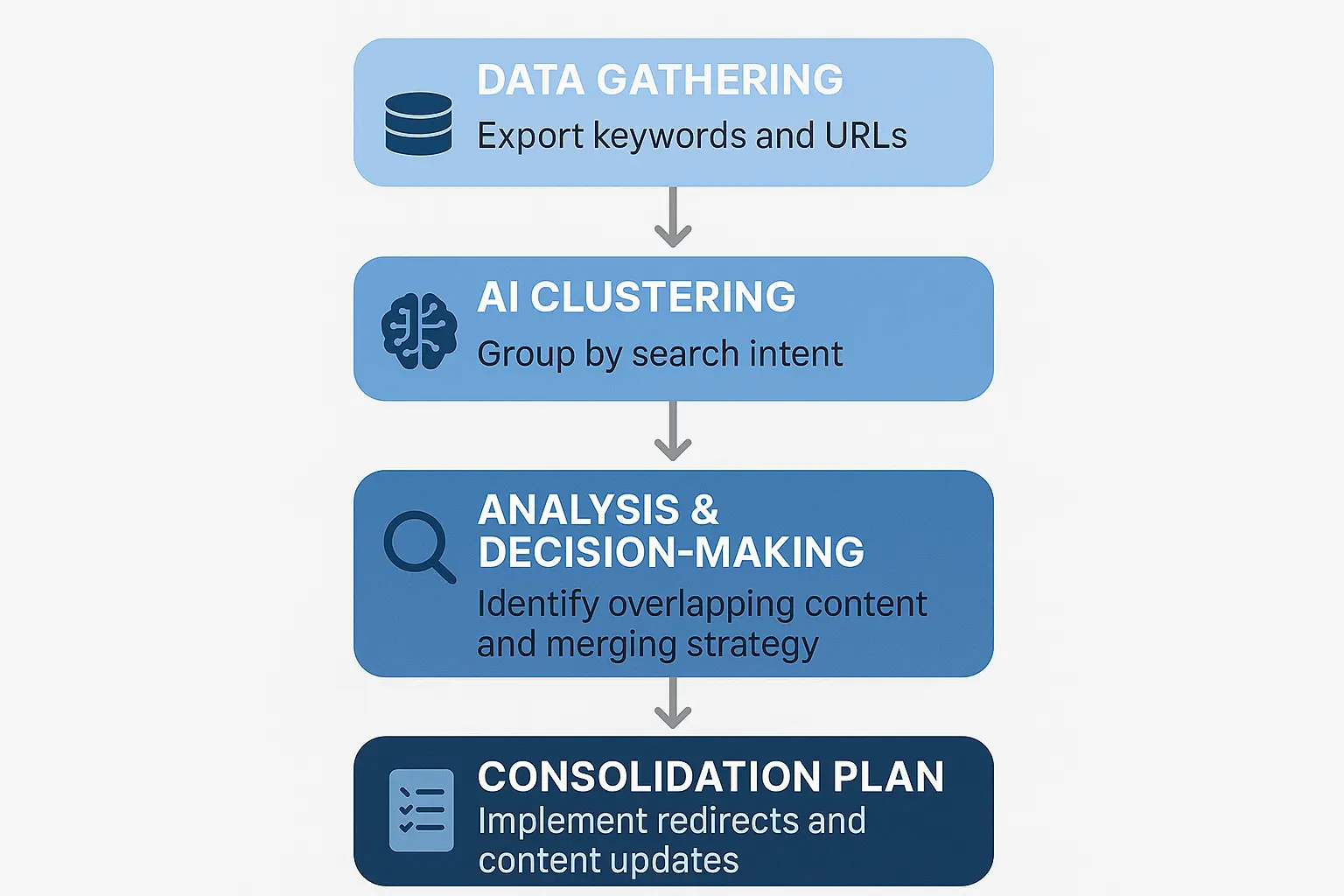
This is a game-changer because it moves beyond human guesswork and reveals the true topical structure of your digital landscape. It’s a core component of how modern AI-powered SEO automation transforms chaotic content libraries into clean, authoritative hubs.
A 3-Step Blueprint for Fixing Cannibalization with AI
Using AI clustering, you can audit an entire website and create a clear consolidation plan in a fraction of the time it would take manually.
Step 1: The AI-Driven Content Audit
The process begins with your data. Export a list of all your website’s ranking keywords from a tool like Google Search Console or Ahrefs, along with their corresponding URLs. Feed this data into an AI clustering tool, which will analyze the SERPs for each keyword and group them into intent-based clusters.
Step 2: Identify the Cannibals
This is the “aha” moment. Once the clustering is complete, simply scan the output. Any cluster containing more than one of your website’s URLs is a red flag.
If a single cluster—representing one core search intent—contains three of your blog posts, you’ve found a cannibalization issue. The AI has confirmed that Google sees these three pages as competing for the same audience.
Step 3: Create a Consolidation Plan
Now that you’ve identified the problem areas, it’s time to act. For each cannibalizing cluster, choose one of three paths:
-
Keep & Consolidate: Identify the strongest page in the group—the one with the most traffic, backlinks, or best conversions. This becomes your “canonical” page. Merge the valuable content from the weaker pages into this primary page to make it even more comprehensive. Then, set up 301 redirects from the old pages to the primary one to pass along their link equity and traffic.
-
Repurpose: If a competing page targets a slightly different but valuable sub-topic, consider re-optimizing it for that new niche. Change the title tag, headers, and body content to serve a distinct, non-competing intent.
-
Prune: If a cannibalizing page is thin, outdated, and offers no unique value, it might be best to delete it and redirect its URL to the primary page or a relevant category page.
By systematically working through these clusters, you transform a messy, competitive structure into a clean, logical one where every page has a unique job to do.
Why a Clean Architecture Is Essential for Growth
Fixing keyword cannibalization isn’t just about cleaning up old mistakes; it’s about setting a foundation for future growth. Google’s algorithm increasingly favors sites with clear topical authority—deep expertise on a specific subject. Consolidating your content is the fastest way to build it.
The industry is rapidly moving in this direction. Gartner predicts that 80% of SEOs will use AI for keyword clustering by 2027, while Forrester reports that AI will automate 20% of content creation by 2025. Agencies that embrace this data-driven approach will build more efficient and effective strategies for their clients.
For many agencies, executing this level of technical analysis across an entire client roster is a major challenge. This is where specialized white-label SEO services become a powerful asset, providing the deep technical expertise and tools needed to execute these projects at scale.
Frequently Asked Questions About Keyword Cannibalization
What’s the difference between cannibalization and targeting related keywords?
Targeting related keywords is smart SEO. For example, you might have one page for “how to start a podcast” and another for “best podcasting microphones.” These serve different intents (informational vs. commercial) and can coexist perfectly. Cannibalization occurs when both pages target the same informational intent, like “how to start a podcast” and “a beginner’s guide to podcasting.”
How long does it take to see results after fixing cannibalization?
After you’ve consolidated content and implemented 301 redirects, it can take anywhere from a few weeks to a few months for Google to recrawl the pages and update its index. You’ll often see positive ranking movement as the authority consolidates onto a single page.
Should I just delete the weaker pages?
It’s almost always better to use a 301 redirect. Deleting a page throws away any backlinks or “link juice” it has accumulated. A 301 redirect tells search engines that the page has permanently moved, passing most of its authority to the new, consolidated page.
Is keyword cannibalization always bad?
In 99% of cases for informational and commercial content, it is. There are rare exceptions, such as for news websites with multiple articles covering a breaking story from different angles, or for large e-commerce sites targeting brand terms with both category and product pages. For most businesses, however, it’s a problem to be solved.
From Content Chaos to Strategic Clarity
Stop competing with yourself. Your content should work together, not against itself, to build a fortress of topical authority that both users and search engines trust.
By shifting from a manual, keyword-focused process to an AI-driven, intent-based one, you can finally put an end to keyword cannibalization. This doesn’t just improve rankings; it streamlines your entire content workflow, ensuring every piece you create has a clear and unique purpose.
It’s the first step to building a truly scalable SEO strategy—one that allows your agency to deliver better results more efficiently. And if you’re looking for ways to scale SEO without hiring, optimizing your existing content architecture is the most powerful place to start.